 White Papers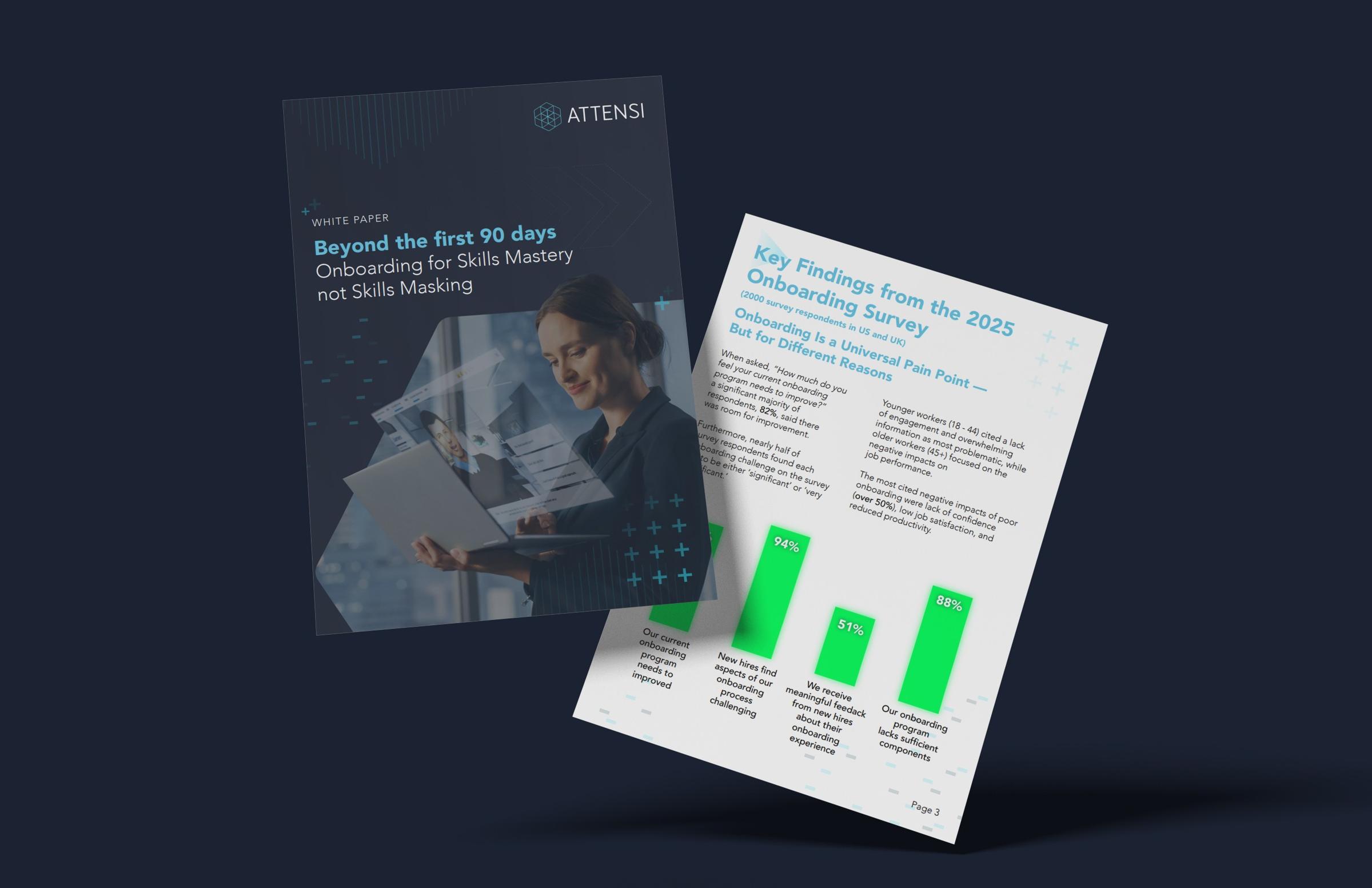
White paper
Onboarding for Skills Mastery not Skills Masking
Plug Skills Gaps to Futureproof the Workforce - 82% of employees say onboarding needs improvement - 58% admit to “skills masking” - 1 in 3 workers under 45 report skill-set anxiety - Skills gaps are business risks. Discover how leading brands like YMCA, EQ, and Circle K are transforming onboarding with gamified simulations that build confidence, close gaps, and deliver measurable ROI

Team Attensi
Published · Updated
Join industry leaders who are changing the game with Attensi
Summary
Key findings
- Based on an independent survey of 2,000 employees in the US and the UK, commissioned by Attensi.
- The report highlights a “skills masking” crisis in onboarding, featured in The Hill.
- Onboarding is challenging for everyone, but the nature of the challenge differs by generation and employment type.
- Confidence, engagement and psychological safety are highly predictive of onboarding success.
- Organizations risk missing opportunities by underestimating the importance of data and analysis.

As featured in The Hill report from Washington DC, this survey highlights a "skills masking crisis" - just one of the challenges, perceptions, and improvement strategies surrounding employee onboarding and learning and development (L&D) programs across a diverse workforce. It explores how generational and employment status differences influence experiences with onboarding, confidence, and skill development. The study also examines how organizations measure onboarding success, the adoption of technology and data analytics, and employee openness to innovative solutions like AI-powered training. By capturing both structural gaps and emotional realities, such as skills gaps anxiety and resistance to feedback, this paper aims to inform more effective, inclusive, and data-driven onboarding practices.
- Onboarding is universally challenging, but the nature of the challenge differs by generation and employment type
- Confidence, engagement, and psychological safety are highly predictive of onboarding success
- Organizations risk missing opportunities by underestimating the importance of data and analysis
Full Data: Attensi commissioned an independent survey of 2,000 employees in the US and the UK.
Key findings from the 2025 Onboarding Survey
Onboarding is a universal pain point — but for different reasons
82%
say their current onboarding program needs to improve
94%
say new hires find aspects of the onboarding process challenging
51%
say they receive meaningful feedback from new hires about their onboarding experience
88%
say their onboarding program lacks sufficient components
Confidence is the biggest casualty of poor onboarding
Younger workers (18–44) cited a lack of engagement and overwhelming information as most problematic, while older workers (45+) focused on the negative impacts on job performance. The most cited negative impacts of poor onboarding were lack of confidence (over 50%), low job satisfaction, and reduced productivity.
- 55% say poor onboarding impacts confidence — rising to 60% among 18-24 year-olds
- 52% say it impacts job satisfaction, and 52% say it reduces productivity
- 48% say it negatively affects job performance
- 81% of 18-24 year-olds feel their onboarding success is negatively impacted by problems retaining information — similar figures were found for the 25-34 and 35-44 age groups

Skills masking and skills gap anxiety are widespread
58%
of respondents reported experiencing skill masking — hiding or downplaying skill gaps to avoid judgment
1 in 3
workers under 45 report skill-set anxiety
72%
agree mentorship or buddy systems play a crucial role in onboarding
67%
said "learning-by-doing" through realistic AI game-based conversation simulations would improve onboarding — rising to 79% among 25-34s
AI-powered training tools have strong appeal
Impact data measurement is common, but not standardized
92%
of organizations measure onboarding success, but no single metric dominates
49%
use feedback surveys — the most common metric, indicating a fragmented approach
71%
agree better analysis of training impact would secure more L&D funding
78%
agree better onboarding practices can reduce employee churn
Case studies
Onboarding in action
YMCA: transforming onboarding with Attensi
The YMCA of Metropolitan Dallas faced high staff turnover and struggled to meet the demand for consistent, high-quality training content at scale for its diverse workforce of over 2,200 full-time, part-time and seasonal staff. By partnering with Attensi, they implemented gamified simulations that allowed new hires to practice real-world scenarios in a safe environment — improving confidence, reducing time to competence, and increasing engagement.
"All of our staff now, all 2,200 staff, are all onboarded the same exact way."
Suzanne Goswick
Senior VP & CHRO, Y Dallas

58%
reduction in employee turnover
88%
satisfaction with the training recorded by managers
88%
overall satisfaction rates recorded for new joiners
Circle K

Circle K needed a way to deliver a large volume of product and process information to new hires across its stores in Europe and the US — without making onboarding feel like homework. The fix was game-based training built to make dense material easy to absorb and simple to measure.
"Working closely with Attensi, we crafted a solution to deliver a large amount of information in an engaging, digestible, and measurable way. Our game-based training addresses onboarding struggles in Europe and the U.S. Effective onboarding is crucial — high engagement levels, where new employees enjoy and benefit from the training, lead to happier teams, satisfied customers, and higher retention."
Sue Vandersall, Senior VP of Global Talent Development at Circle K, explains the thinking behind the approach.
That shift from dense information to an engaging experience didn't just make onboarding easier to sit through — it changed how leadership talks about its own people. Circle K describes the impact less in terms of modules completed, and more in terms of who their staff become at work.
"Our people are like rockstars and we can set them up for success."
Jens Rye of Circle K adds.
That confidence translated into something measurable on the shop floor. New hires who'd gone through the training weren't just getting through their shifts — they were selling more, and sticking around longer.
"It has helped us increase merchandise sales and basket size while reducing employee turnover."
Kristian Planke Styrmo of Circle K notes.
14K
employees engaged in "Beat the Boss"
96%
knowledge gap closure
EQ
Simulated experiential training was vital for proficiency at EQ, significantly reducing time to competency.
"Attensi puts people in the position of having more confidence when they arrive on the phone and they are dealing with those real-world situations. Repetition is extremely important — especially in this job. [Simulations] allow people to get more experience. Really you can only get to a point of proficiency in this role through experience. Attensi allows us to ramp up that experience."
John Horvarth
Operations, Product and Client Services, EQ

3x
ROI thanks to reduced training times and reduced staff churn
40%
reduction in training time
88%
knowledge gap closure
Deep dive
Survey analysis and insights
"The data shows a clear mismatch between how organizations evaluate onboarding and what employees actually experience. Too often, success is measured by checklists, not mastery and confidence. And when employees don't feel safe learning in person, they mask their gaps rather than close them."
Trond Aas
CEO, Attensi

This phenomenon, rooted in what the study terms skill-set anxiety, is especially pronounced among younger workers. Over half of employees aged 18-44 report frequent worries about being underqualified, and 29% say this anxiety strongly reflects their experience on the job. Importantly, these feelings take root early: the most common reported consequence of poor onboarding isn't churn or performance — but diminished confidence (55%).
Yet the report offers hope. Despite the stigma, 58% of employees say they would feel comfortable admitting skill gaps to a manager, and two-thirds (67%) express willingness to use confidential, AI-powered role-play tools to practice and strengthen job-critical skills privately.
"The good news is that technology is catching up to human psychology. AI-powered simulations now allow people to rehearse tough conversations, practice decision-making, and close real skill gaps without fear of embarrassment. For organizations serious about performance, the key is creating environments where people can safely stop pretending and start progressing."
Trond Aas
CEO, Attensi
Digital transformation is leaving older generations behind — but it doesn't have to
As onboarding tools become more digital, data-driven and AI-enhanced, organizations are accelerating their investments in scalable learning solutions. But the survey reveals a blind spot: older generations are less likely to feel included in this evolution. They're more sceptical of gamification, less confident in analytics, and less likely to find value in feedback systems and mentorship models — 11% of older respondents are "Onboarding Skeptics," compared to just 4% of younger respondents.
Digital transformation is inevitable. Generational inclusivity isn't. It has to be intentional.

Learning & development is undervalued
Frequently asked questions
FAQ about the white paper
Can’t find what you’re looking for? Talk to our team.
It explores the challenges, perceptions and improvement strategies around onboarding and learning and development: how generation and employment status shape onboarding experiences, how organizations measure onboarding success, the use of technology and data analytics, and employee openness to AI-powered training.
Attensi commissioned an independent survey of 2,000 employees in the US and the UK.
Confidence, engagement and psychological safety are all highly predictive of whether onboarding succeeds.
Click the “Download our white paper” button.
You might also be interested in
White Papers White Papers
 White Papers
April 20, 2026 · 5 min read
95% Less Training Time. Sharper Underwriters.
 White Papers
May 23, 2025 · 5 min read