
 Insights
Insights
What is AI role-play training? How it works and where it pays off
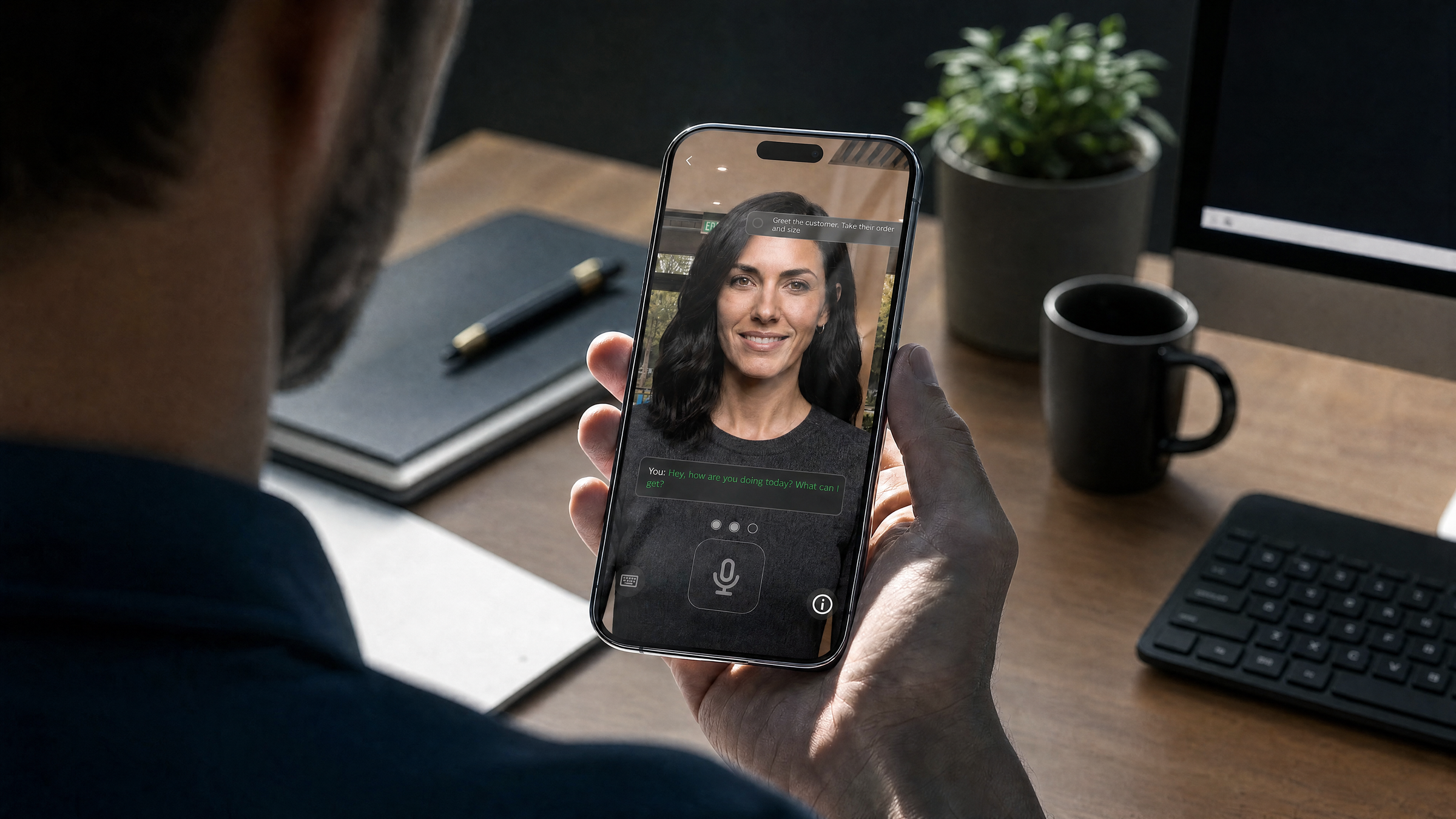
AI role-play training lets employees practice real workplace conversations with an AI character that responds like a person and gives instant feedback. Here's how it works, where it pays off, and how to tell if it's actually changing behavior.

Karen Klakegg · VP of Marketing
How AI role-play differs from classroom role-play and e-learning
AI role-play
Classroom role-play
E-learning module
How often people can practice
AI role-playUnlimited, on demand
Classroom role-playOnce or twice, when a session is scheduled
E-learning moduleUnlimited, but no real conversation
Who plays the other side
AI role-playAn AI character that adapts to the learner
Classroom role-playA colleague reading a script
E-learning moduleNobody
Feedback
AI role-playSpecific and immediate, every time
Classroom role-playDepends on the facilitator
E-learning moduleRight or wrong answers
Safe to get it wrong?
AI role-playYes, in private
Classroom role-playNot really, people are watching
E-learning moduleYes, but there's little to get wrong
Scale across sites and languages
AI role-playEasy
Classroom role-playHard and expensive
E-learning moduleEasy
Why practice matters, in numbers
77%
of workers say they can't master new skills without practicing them
84%
say practicing in a safe environment helps them learn faster
92%
of DNV surveyors improved their score when they repeated the AI role-play
20%
average score increase from first to best attempt at DNV
Where AI role-play training works best
AI role-play earns its place wherever a conversation can make or break the outcome, for frontline teams and managers alike. The most common use cases:
- Customer conversations. Handling complaints, upselling without sounding pushy, de-escalating a tense moment at the counter or on the phone.
- Patient and care interactions. Explaining a procedure, responding to a worried relative, staying calm when someone is upset.
- Manager conversations. Giving feedback, running a performance review, addressing a conflict in the team. These are the conversations managers most often postpone, and the ones they get least chance to practice.
- Compliance moments. Refusing a sale that breaks the rules, spotting a red flag, speaking up when something isn't right.
In each case the goal is the same. The first time someone handles a hard conversation shouldn't be the time it really counts.
How to tell if AI role-play training is working
The easiest number to report is completions, and it's the least useful. A completion rate tells you people showed up. It doesn't tell you whether they handle the conversation better. Better measures to track:
- Skill progression inside the practice. Are learners' scores and feedback improving from the first attempt to the fifth?
- Confidence before and after. Short self-assessments are simple to run and show whether people feel ready for the real thing.
- Behavior at work. Mystery shopper scores, call quality reviews, customer satisfaction, complaint rates, or manager observations.
- Business results. Conversion, average transaction value, retention, or fewer escalations, depending on the conversation you're training.
Progression is often the first signal. At DNV, surveyors used AI role-play to practice the customer conversations that are hardest to get right. 92% improved their score when they repeated the training, and scores rose 20% on average from first to best attempt.
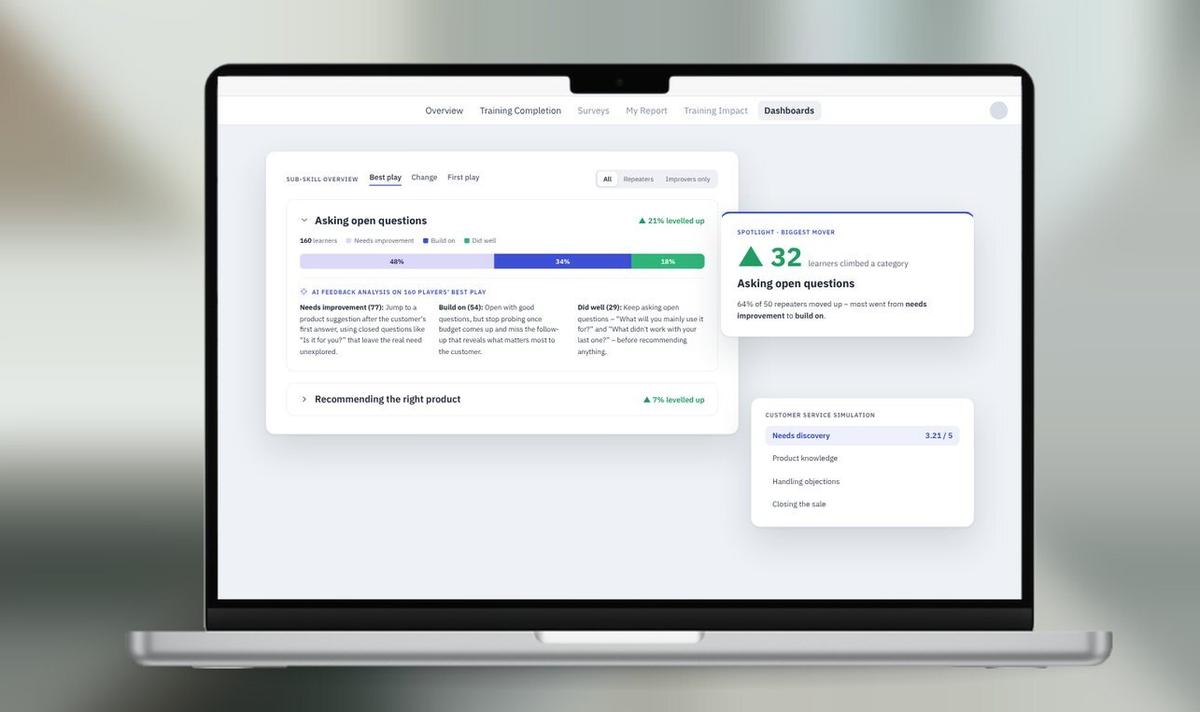
Agree up front which business metric the training should move, and measure it before you start. That's what turns a training program into a business case.
What AI role-play can't do on its own
It's worth being honest about the limits. An AI role-play without good scenario- and learning design is just a chatbot with a costume. The scenarios need to reflect the real conversations your people have, in your language, with your standards.
Feedback also needs to be specific. "Good job" teaches nothing. "You acknowledged the customer's frustration, but you offered a solution before you understood the problem" gives the learner something to do differently next time.
This type of training also works best as part of a wider program or continuous practice area: short, regular practice sessions, connected to the skills and knowledge people need in the role, with managers who reinforce the behavior back on the floor.
Why game design matters in AI role-play
Here's something people rarely say about AI role-play: it can be hard. Just like the classroom version, a tough customer who won't back down or a patient who keeps asking the question you can't answer is uncomfortable. That's the point. But it's also why many learners try once and never come back.
Pure software role-plays often stop at the conversation. Drop the learner into a scenario, score them, done. What they miss is the dynamic that makes people want to keep going. Game designers have spent decades solving exactly that problem:
- Difficulty that builds. Scenarios start manageable and get harder as the learner improves, with peaks of challenge followed by moments of success. People stay in the zone between bored and overwhelmed.
- Clear goals and visible progress. Learners know what good looks like and can see themselves getting closer, attempt by attempt.
- Characters and stakes that feel real. A believable person in a believable setting makes the conversation matter, so people care about getting it right.
- Reasons to come back. Scores to beat, new scenarios to unlock, and short sessions that fit into a working day turn one-off practice into a habit.
That's what turns AI role-play from something people complete into something they repeat. And repetition is where the skill gets built.
It's also where Attensi is different. For more than a decade, our game designers have worked alongside learning experts to build training people actually want to play. Every AI role-play scenario is designed as a positive experience with the right learning curve, not just a test.
Getting started
If you're considering AI role-play training, start small and specific:
- Pick one conversation or conversation type that matters to the business and that people find hard.
- Build two or three realistic scenarios around it.
- Agree the business metric you expect it to move.
- Run a short pilot with a group that wants to try it, and compare results with a group that doesn't.
Attensi's AI role-play solution lets frontline teams and managers practice the conversations that are hardest to get right, from an unhappy customer to a difficult feedback conversation, with AI avatars that push back and scored feedback in minutes, on mobile or desktop. It sits alongside skills-based training and 3D environment simulations, and insights and analytics connect practice to performance.
Frequently asked questions about AI role-play training
AI role-play training lets employees practice workplace conversations with an AI character that responds in real time and gives instant, specific feedback on what they said.
Attensi's AI role-play solution lets frontline teams and managers practice the conversations that are hardest to get right, from an unhappy customer to a difficult feedback conversation, with AI avatars that push back and scored feedback in minutes, on mobile or desktop.
A chatbot answers questions. An AI role-play character plays a part, such as a customer, patient, or team member, so the learner can practice handling a real conversation and get feedback on how they did.
AI role-play can be challenging, which is why many learners try it once and stop. Game design adds difficulty that builds over time, visible progress, believable characters, and reasons to come back, so people repeat the practice that builds the skill.
Any skill that depends on a conversation: customer service, sales conversations, de-escalation, patient communication, feedback and coaching for managers, and compliance situations.
No. It gives people far more practice than a trainer or manager could provide one to one. Trainers design the scenarios and coach on the results. Managers reinforce the behavior at work.
Track skill progression inside the practice, confidence before and after, behavior at work (such as mystery shopper or call quality scores), and the business metric the conversation affects.
Yes. Sessions can be short, mobile-friendly, and available in many languages, so frontline staff can practice before a shift or between tasks.
Try it yourself
See what AI role-play feels like from the learner's side. Book a demo.
You might also be interested in
Insights Insights
September 26, 2026 · 6 min read
How to change behavior through game design
 Insights
September 26, 2026 · 7 min read
Can you train emotionally intelligent teams?
 Insights