


Gjensidige: Playing to win in sustainable business
Insurance giant Gjensidige invests in Attensi’s game-based training to promote its green credentials.
Playing to win in sustainable business
In a single generation the issue of sustainability has moved from a fringe concern to the top of the agenda for Norwegian business. Where once a firm’s success was measured by how much money it made, now it’s all about the three Ps – Planet, People and Profit.
A respect for all three is the price of doing business for every company when society – including investors, consumers and potential employees – increasingly insist that the brands they support serve as good corporate citizens.
This shift in attitudes means that a reverence for what is known as ESG – Environmental, Social and Governance – matters as much as revenue and expenditure.
Beyond tokenism
According to McKinsey1, companies with high ESG scores consistently outperform the market in the medium and long term. The challenge for businesses is how to embed a culture of sustainability in their operations in a way that goes beyond tokenism.
The answer to this challenge is staff training which is fun, easy to follow and flexible, so every worker at every level can master the skills and knowledge they need to display a commitment to sustainability.
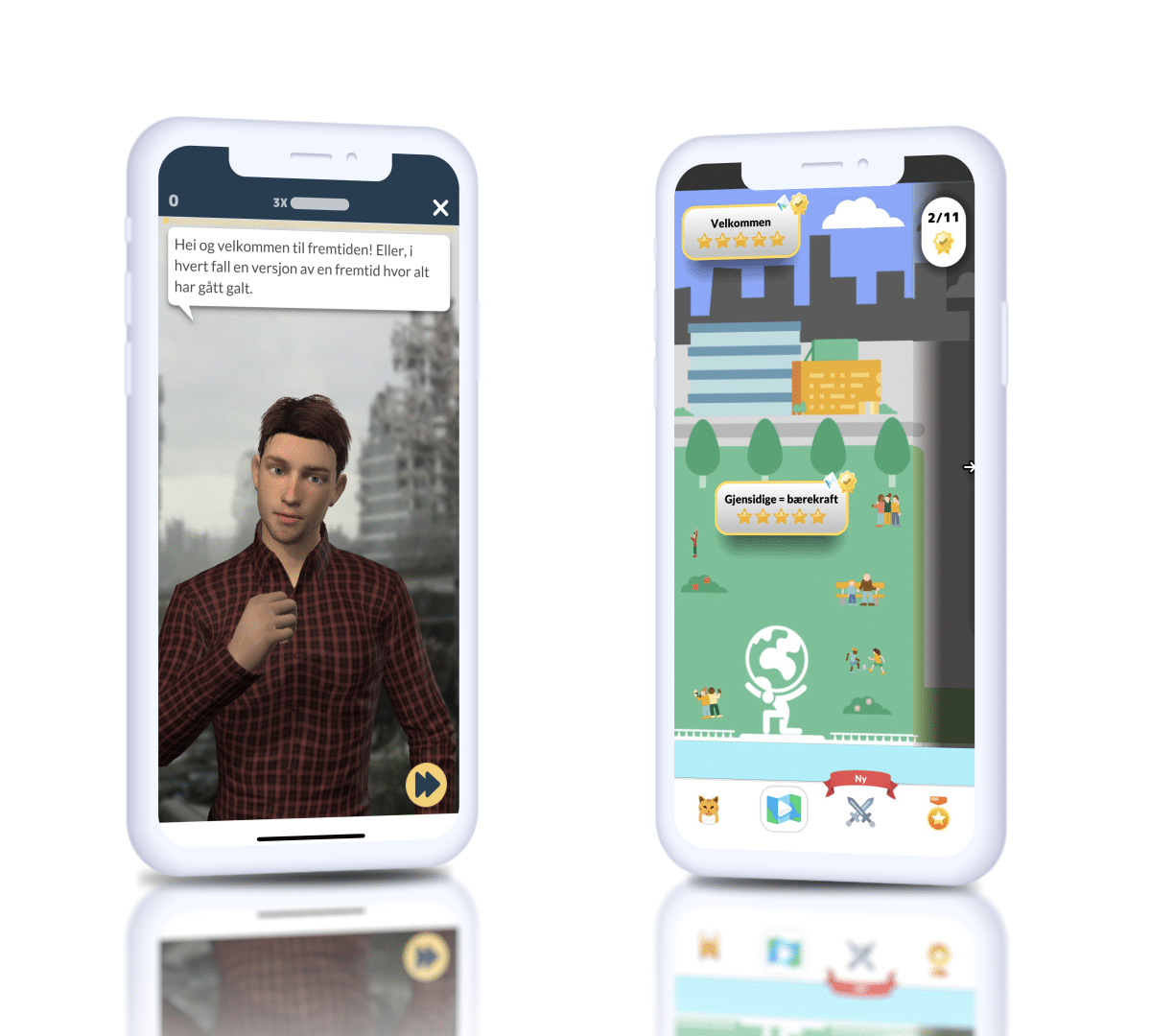
Insurance company Gjensidige found the solution with world-leading, Norwegian game-based training expert, Attensi. Partnering together, Gjensidige and Attensi used real-life scenarios to create playable scenarios where staff could recreate typical interactions with customers.
“Sustainability is one of the biggest challenges facing companies today,” says Christian Kavli, Attensi’s Head of Professional and Financial Services for Norway and the EU.
“And the challenge we face with our customers is that they often don’t know where to start to engage the employees and get them on board with the change that is needed.”
Learning sticks
Attensi’s game-based simulations give employees the chance to learn new skills and fresh ways to communicate sustainability in a safe, risk-free environment where they can repeat training.
The training – named The Sustainability Game – is based on gaming mechanics and techniques which people already know, love and understand. The simulations are bite-sized and available on devices like phones and tablets so training can be completed anytime, anywhere.
Gaming features, including points-scoring and leaderboards, drive friendly competition, meaning employees want to play the games repeatedly – so the learning sticks.
Are you ready to level up your training?
You might also be interested in





London Business School
Read their story: Practice makes perfect for London Business School students "When we first saw the examples, we were blown away."
Practice makes perfect for London Business School students



3x ROI in reduced training times and staff churn