
(not) Reinventing the Wheel · Part 1 of 10
Flossing, unused gym cards and the 10% that never was
Flossing, unused gym cards and a statistic nobody ever measured have one thing in common: knowing how to do something and actually doing it are two different problems.
This is part 1 of (not) Reinventing the Wheel, Attensi's series on the science of changing what people actually do at work, one idea at a time.

Sondre Lien Julsrud · Director of Behavioral Science
Published
Key takeaways
The claim that only 10% of training transfers to the job has no data behind it. It comes from a hypothetical quote in a 1982 article.
Knowing how to do something and doing it are separate problems. Research shows people act on their intentions only about half the time.
Before building a training, decide whether people need to know something or do something differently. The two call for different designs.
When did you last floss?
The tough question most of us dread getting upon a visit to the dentist. We all know we should. It’s not really rocket science either, so it’s not as though we don’t know how to do it. And while seated in the chair, mouth opened wide and under the dentist’s stern gaze, we might promise that we’ll actually start doing it. And in that moment, we might really mean to. Still, a year later, back in the chair, we find ourselves in the exact same situation. And again the year after.
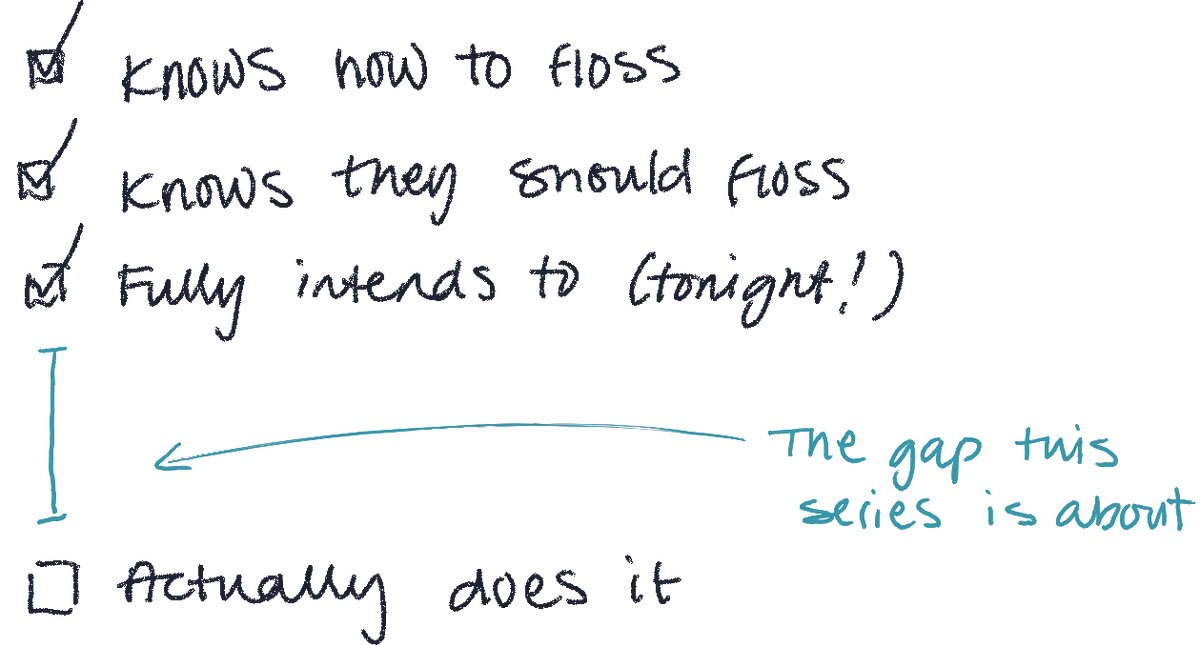
Knowing you should floss, knowing how and fully intending to are all in place. Actually doing it is the part that’s missing.
Training has the same problem. Imagine an onboarding program for store staff; everyone completes it, the quiz scores are great and glowing feedback all around. People really learned something! …right? Six weeks later, new hires still skip the initial greeting, cry for help at the first sight of a return and vanish mysteriously in their first month. What in the world went wrong?
Annoyingly, nothing. The training did exactly what it was supposed to: it provided knowledge. There’s nothing wrong with that, and knowledge does play a key role in behavior change, which we’ll return to later in this series. The problem is that knowledge on its own isn’t enough to make people change their ways (take that, Plato! — see note 1 below). If decades of dental advice haven’t made devout flossers of us all, expecting just one more e-learning to be the cure-all for cashiers not greeting customers is… Well, I’ll let you choose the appropriate adjective to complete that sentence.
An elusive statistic from 1982
If you’ve spent more than a week in L&D, you’ve probably had someone tell you only about 10% of training content transfers to the actual job. Pretty catchy, right? It has a lot of the makings of a great statistic; it’s gloomy, it’s precise and has people reaching for their phone to grab a quick photo if presented on a slide. There’s one tiny problem though. It has no basis.

The 10% figure is one of the most quoted numbers in L&D, but it comes from a single hypothetical quote in 1982. No data was ever collected to support it.
1982 was a great year. Survivor’s “Eye of the Tiger” topped the charts, Ridley Scott’s “Blade Runner” came out (if you haven’t seen it, you have plans tonight) and Ozzy Osbourne mistook a bat for a rubber toy and bit its head off on stage — see note 2 below.
Coincidentally, it’s also the year David L. Georgenson, then a product development manager at Xerox Learning Systems, opened an article in Training and Development Journal by putting these words in the mouth of a hypothetical training director: “I would estimate that only 10 percent of content which is presented in the classroom is reflected in behavioral change on the job.” That’s it. That’s the whole basis for the statistic. Not a study, not a survey, not even one person’s estimate of their own program. Somehow, in the game of telephone and citations that followed, Georgenson’s invented quote went from illustration to established empirical finding. Isn’t it funny how a rumor that travels well can become too good to check?
Transfer researchers have since gone looking for the evidence behind it and found none. They counted 35 articles and book chapters repeating the figure, and gave it a fitting name: “the 10% delusion” (Ford, Yelon & Billington, 2011).
“That famous 10% statistic is almost certainly fiction. The problem behind it isn’t. Plenty of training is meant to deliver knowledge, and does that well. What we see across our clients is how often the real goal is for someone to act differently, and knowledge alone doesn’t get you there. That’s why we measure what people do, not just what they know.”
Less catchy, far more useful
Transfer of training is the extent to which what people learn in training gets applied on the job, and keeps being applied over time. (Less formally: did any of this show up at work?) Studies of transfer usually find that it depends on a handful of things. Internal factors, such as learners’ confidence and their motivation to apply it, but also what happens after the training: support from managers, a workplace that rewards the new way of working and a chance to use the newly acquired skill before it evaporates (Grossman & Salas, 2011; Blume et al., 2010).
That’s not the end of it though. You might have noticed motivation on that list, which could create the impression that if a training succeeds in motivating learners to do something, they’ll surely end up doing it, right? Wrong. Unfortunately, the waters are further muddied by what is usually known as “the intention–behavior gap”. This gap, between what people intend to do and what they actually end up doing, is one of the most robust and replicated findings in psychology and behavioral science.
It’s a well-known fact that everything sounds cooler if you slap the word “meta” in front of it. That’s why one of the coolest things in science is meta-analyses. Not only because of the name, but because a meta-analysis combines the results of multiple independent studies and forms the most robust basis for scientific findings within a certain field or topic. Do you know what’s even cooler than a meta-analysis though? That’s right, a meta-meta-analysis — see note 3 below.
One such analysis, reviewing the findings of 10 meta-analyses, and a whopping 422 independent studies, found that intentions (what people intend) predict behavior well, yet people only act on those intentions about half the time (Sheeran, 2002; Sheeran & Webb, 2016). These findings are echoed in experiments. Across 47 of them, a medium-to-large change in intentions (an effect size of d = 0.66) produced only a small-to-medium change in behavior (d = 0.36; Webb & Sheeran, 2006). Shifting what people intend got only about half as far when it came to what they actually did. If you’ve put money down for a gym membership in January with the intention of turning heads on the beach later the same year, you already know this finding well. Same thing if you have a nice pack of dental floss waiting to be used in your bathroom cabinet. If you’re feeling guilty right now, rest easy: the unused gym card or floss is not a character flaw on your part. It just means the barrier for using them sits somewhere else.
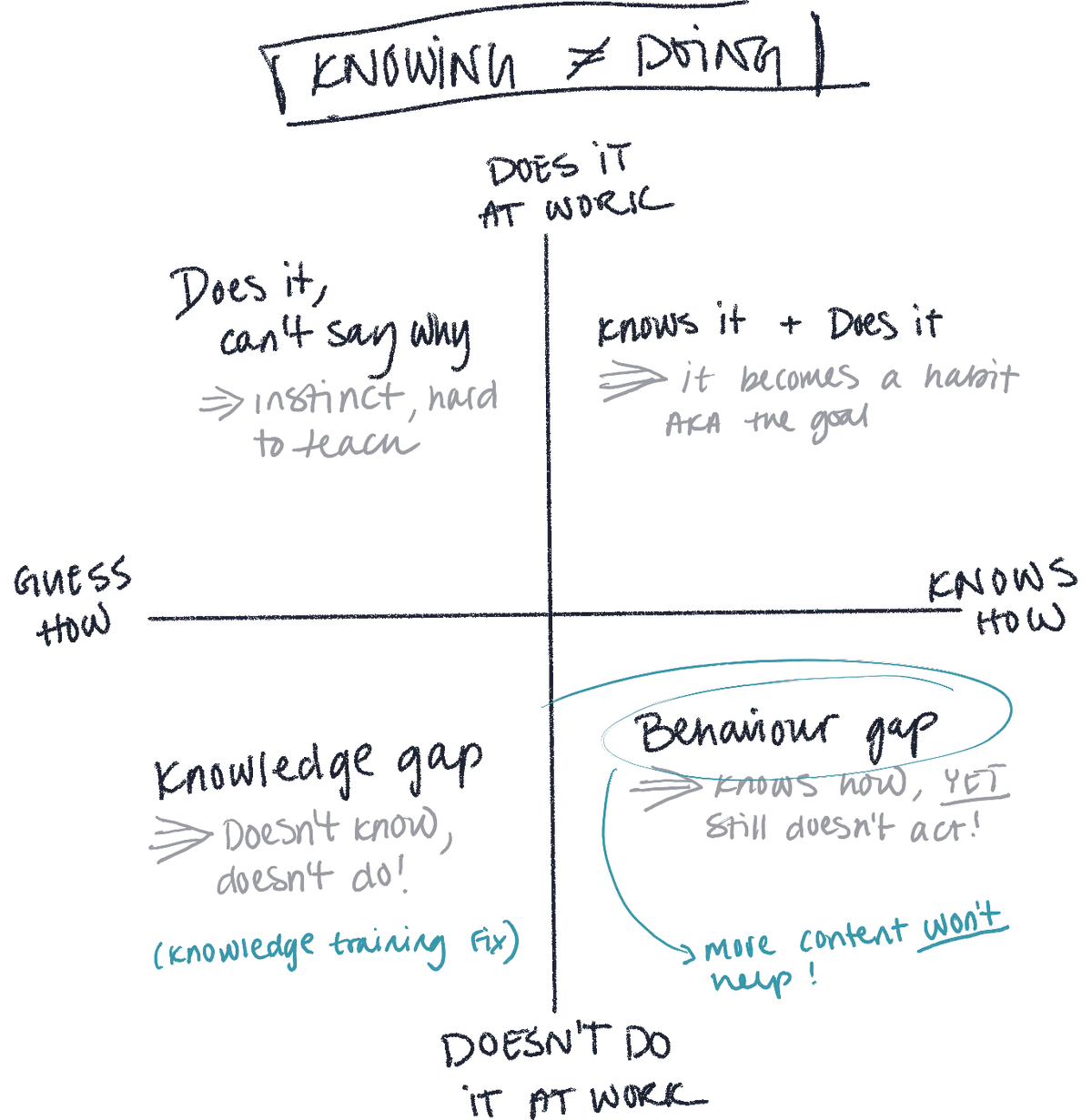
Most training moves people from the knowledge gap (bottom left) to the behavior gap (bottom right): they now know how, but still don’t do it. The interesting part is the trip upward, to knowing and doing.
Two kinds of training (and why mixing them up is a bad idea)
| Knowledge training | Behavior-change training | |
|---|---|---|
| Starting point | Knowledge trainingContent to know | Behavior-change trainingA specific behavior |
| Asks | Knowledge trainingWhat should they learn? | Behavior-change trainingWhat should they do differently, and what stops them? |
| Success looks like | Knowledge trainingPeople remember it | Behavior-change trainingPeople do it on the job |
| Design focus | Knowledge trainingClear explanation | Behavior-change trainingPractice, confidence and the conditions at work |
Fieldwork: three questions before building a training
Next up: part 2
Your GPS doesn’t tell you to “drive better”
Why goals like “better customer service” can’t be trained or measured, and what a turn-by-turn instruction knows about asking for exactly the right thing.
Frequently asked questions
Transfer of training is the extent to which what people learn in training gets applied on the job, and keeps being applied over time. Research shows it depends on learner factors such as confidence and motivation, and on the work environment, including manager support and the chance to use the new skill soon after training.
No. The claim that only 10% of training transfers to the job traces back to a hypothetical quote in a 1982 Training and Development Journal article by David L. Georgenson. No data was collected to support it, and transfer researchers have since called it “the 10% delusion” (Ford, Yelon & Billington, 2011).
The intention–behavior gap is the distance between what people sincerely intend to do and what they actually do. A review of 10 meta-analyses covering 422 studies found that people act on their intentions only about half the time (Sheeran, 2002).
Knowledge training starts from content people need to know and succeeds when they remember it. Behavior-change training starts from a specific behavior and succeeds when people do it on the job, which means designing for practice, confidence and the conditions at work, not just clear explanation.

Stay in the know